العربية 


القربي لـ «الحياة»: الدعم المالي لـ «الحوثيين» من مراجع شيعية داخل إيران وخارجها
01/25/10


Raghida Dergham Speaks at The Worldwide Alumni
Association of the American University of Beirut
Fairmont Queen Elizabeth Hotel
- Montreal - 10/09/2009

وزير خارجية عمان لـ«الحياة»: لا مصلحة للعرب في العداء مع طهران
2009/10/01

وزير خارجية البحرين لـ«الحياة»:ندفع ثمن ضرب إيران أو اتفاق معها

2009/09/30


أبو الغيط لـ«الحياة»: الأيام المقبلة حاسمة لمصير جهود المصالحة الفلسطينية

2009/09/29

طالباني لـ«الحياة»: توافق أميركي - إيراني ضمني في العراق
2009/09/27

ميشال سليمان لـ «الحياة»: لا دور سورياً أو إيرانياً سلبياً في لبنان الآن
2009/09/26

عباس لـ«الحياة»: الخلاف مع إسرائيل جذري... وسيستمر طويلاً
2009/09/23

راغدة درغام: حاربت من أجل حياتي

2009/09/02

لقاء مع ثاليا درغام، ابنة راغدة درغام، في مجلة  لها
October Edition

Raghida Dergham, professionnelle jusqu’au bout du mot
L’Orient-Le Jour- 08/10/2009

Thalia Dergham launches new CD “Interval” at Virgin in Beirut
starscene.dailystar.com.lb - 10/30/2009

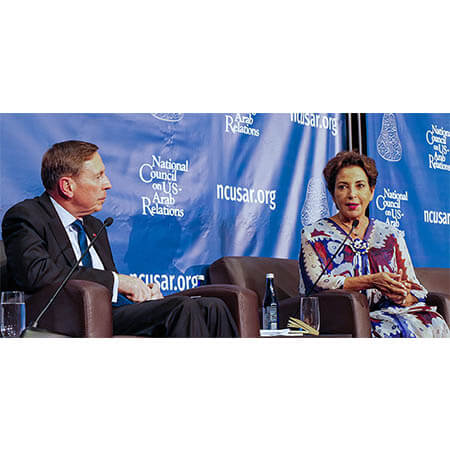
Interview: Raghida Dergham with General David Petraeus


Photo: david abdalla


The fear of isolation has led Iranian President Mahmoud Ahmadinejad to meet with Hezbollah Secretary-General Hassan Nasrallah in Damascus last week, where a tripartite “summit” was held. The fourth party to such a summit, absent from the famous “picture” yet present at the strategic meetings of the so-called “axis of resistance and defiance”, are the leaders of the armed Palestinian factions that assume Damascus as their political headquarters and Lebanon as their military front. Mahmoud Ahmadinejad headed to the Syrian capital carrying various messages directed at the West, especially the United States and France, at the East which is pressuring him, specifically China and Russia, and at the Middle East in both its Arab and Israeli aspects. The main heading of such a message is that the Islamic Republic of Iran holds the keys of war through Lebanon, not just through Hezbollah but also through armed Palestinian factions, and that the pledges and reassurances put forth by any other party are of no use. The other message, directed by Ahmadinejad at the Syrian leadership, is that raising the war agenda is an Iranian decision par excellence at this juncture, especially in these times of Western and Eastern courting of Syria, and in these times of isolation besieging Iran, even appearing in the form of inquiries by the likes of Hugo Chavez about escalatory support relations with Iran for the sake of relations of interests that serve him and serve Venezuela. However, one of the most important things the Iranian President wanted to achieve in Damascus was to openly force Syria into the ranks of countries upon which falls the responsibility of war and resistance from their borders with Israel, de facto overturning, even if temporarily, Syria’s constant and declared assurance that negotiation – and not resistance – is its strategic choice. Ahmadinejad also made sure in Damascus to warn against merely thinking of complying with the attempts to gain Syria’s affections coming from the US through diplomacy, the ambassador and promises, as well as those coming from Europe with investments, rehabilitation and breaking an isolation which not long ago was terrifying for Damascus. Indeed, Damascus is nearly alone the main country which, if it complied with desires for it to break its engagement with Iran, would leave Iran in a state of deep isolation. Faced with all of this, the Syrian leadership stands before challenges and highly accurate calculations as it walks on tightropes with both the West and Iran in its bilateral relations with all parties and in highly sensitive areas, most prominently Iraq, Palestine and Lebanon. And here lie the reasons and the potential results, in terms of profit, loss and perhaps risks. The Iranian-Syrian relationship in and towards Iraq is unclear. In fact, it holds strikingly obscure contradictions and interpenetrations with the US-Syrian relationship in Iraq. Indeed, Iraq remains the regional priority for the Islamic Republic of Iran, directly after its utmost priority, which is the survival of the regime. Some may think that Lebanon is the most important scene of Iranian-Syrian cooperation or communication. Lebanon is of course important in this relationship, but Iraq today is nearly more important, placing this relationship under mutual surveillance in this phase.

There is talk about the de facto relationship of understanding and cooperation between the US and Iran over Iraq recently suffering a relapse, the tepid atmosphere reaching the point of Washington taking the decision of returning to the policy-making table, specifically between the cadres of Commander of US Central Command General David Petraeus. There is also talk about an increase in US-Syrian cooperation in Iraq. Some say that Damascus wants to exercise influence towards Iraq by leading a unified Baath Party, but it is not clear whether this is really taking place, and to what extent, as well as whether it is taking place within agreed-upon US-Syrian cooperation. It is a message from Damascus to Washington that includes the various capabilities of Syrian influence in Iraq. It is clear that there is US-Iranian divergence in Iraq, whereas there is US-Syrian convergence there. What is obscure is whether this is taking place by an Iranian-Syrian understanding falling under role distribution, or whether this indicates the gradual and relative success of the European-American strategy based on splitting Syria from Iran. Breaking the engagement with a complete split is not an option for Damascus, yet what is taking place might be a lessening of the degree of engagement. Perhaps the Iranian leadership saw this coming and sent its President to Damascus, where he would voice the message of matters being run from Tehran and would purposely say, during meetings of resistance and defense against Israel, that Iraq is an important part of this axis and of this circle. And because Iraq is in the view of the current regime in Tehran its “backyard”, and has become, after the Iraq war, the achievement and the gift which cannot be relinquished, Tehran is getting ready for any signs, indications or even rumors of US-Syrian cooperation or of a Syrian role perhaps resulting from inter-Arab reconciliation. Thus the equation is of the utmost accuracy for the Syrian leadership, as it walks the tightrope in Iraq in its strategic relationship with Iran and in the balance of its Arab reconciliations. Indeed, what preoccupies the regime in Tehran is not limited to the near-complete isolation that would befall it in case Damascus splits away from it, but it is also preoccupied by the kind of trade-offs that are taking place in the US-Syrian relationship and in inter-Arab reconciliations, specifically that between Saudi Arabia and Syria. And perhaps one of the things the Iranian leadership had in mind when it sent Ahmadinejad to Damascus was to anticipate the trade-offs and to undermine some of the bases of the reconciliations.


Click Here to Subscribe to Raghida's Mailing List

انضم الى قائمتنا البريدية

Click Here to Contact Webmaster

All Rights Reserved
RaghidaDergham.Com
2010